
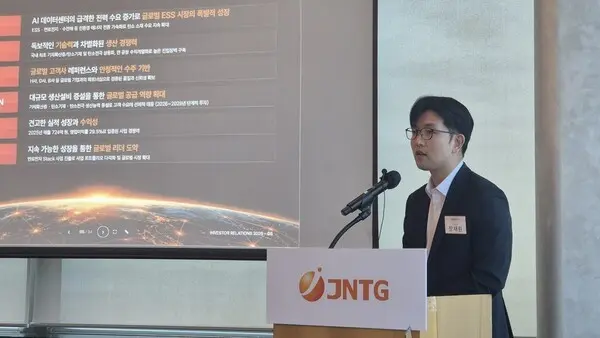
“With three competitive strengths, technological superiority, a highly efficient production system and global customers, we achieved $49.2 million (₩72.4 billion) in revenue last year, up 229.4%. We will invest $46.3 million (₩68.1 billion) of IPO proceeds in production facilities to strengthen our push into the ESS and hydrogen-materials markets.”
That was the growth strategy outlined by JNTG CEO Jang Jae-won at an initial public offering, or IPO, press conference held in Yeouido, Seoul, on Nov. 5. The operating margin last year was 29.5%. First-half revenue this year increased 142.5% from a year earlier to $41.3 million (₩60.7 billion), reaching about 84% of last year’s full-year revenue. The first-half operating margin was 29.9%.
Of the IPO proceeds, the company will invest $46.3 million (₩68.079 billion) in securing a new production site, constructing a factory and expanding production equipment. It said production capacity for carbon electrodes and carbon substrates will each increase by about 1.5 times, while production capacity for gas diffusion layers will rise by about three times.
Founded in 2011, JNTG develops and manufactures carbon electrodes for non-lithium energy storage systems, or ESS, gas diffusion layers for hydrogen fuel cells, and carbon substrates for water electrolysis and distributed power generation. “We began as an in-house research organization in early 2002 and have more than 20 years of development capabilities, and we have developed and internalized the entire process ourselves,” Jang said.
Performance has grown rapidly. Revenue more than tripled to $49.2 million (₩72.4 billion) last year from $15 million (₩22 billion) in 2024, while operating profit swung to a profit of $14.5 million (₩21.3 billion). First-half operating profit this year was $12.3 million (₩18.1 billion). On the company’s unaudited provisional basis stated in its registration statement, cumulative revenue through August was $56.2 million (₩82.6 billion), while operating profit was $17.3 million (₩25.4 billion), exceeding last year’s full-year results.
Jang explained that weak results in 2024 reflected the need for a period of equipment stabilization following large-scale facility investment. “One of our major customers needed time to reorganize its supply chain internally, so we temporarily suspended supply in 2024,” he said. “We resumed supply in 2025 and even achieved the result of signing a long-term agreement.”
Carbon electrodes for long-duration ESS are the core of revenue. Last year, $36.6 million (₩53.9 billion), or 74.5% of total revenue, came from carbon electrodes. First-half carbon-electrode revenue this year was $34.9 million (₩51.4 billion), raising its share to 84.8%.
Jang said demand is increasing for ESS capable of storing electricity for long periods as AI data centers expand and renewable energy grows. “This is not about replacing the lithium-ion market, but rather, depending on the strategic approach to what energy source is supplied at what time and how, the lithium and non-lithium markets are coexisting and growing,” he said.
The first competitive strength Jang cited was technology. The company emphasized that it can mass-produce carbon electrodes, gas diffusion layers and carbon substrates. The second is full-process internalization and a Roll-to-Roll continuous production system. The company explained that while competitors using box-type production equipment require at least three to four days for heating, cooling and other processes, JNTG has adopted Roll-to-Roll continuous production, allowing rolls to be produced in units of minutes. The third is securing global customers. “Based on our global references, we are preparing for the emergence and growth of the ESS and hydrogen markets with more than 40 global companies across the Americas, Europe, China and South Korea,” Jang said.
The hydrogen business is also expanding its customer base. JNTG was selected as a supplier of gas diffusion layers for hydrogen commercial vehicles by a South Korean automaker and is preparing to begin supply in 2027. It has also signed carbon-substrate supply contracts with a South Korean fuel-cell power-generation company and a German water-electrolysis customer.
The company’s stated annual production capacity is 2.4 million square meters of carbon electrodes, 1 million square meters of gas diffusion layers and 1 million carbon-substrate sheets. The company plans to execute investments in stages, considering customer demand forecasts, supply contracts and mass-production plans for new projects.
However, dependence on a specific customer is cited as a challenge. In the first half this year, 83.3% of revenue came from North American non-lithium ESS company A. The amended registration statement listed the possibility of a suspension of transactions due to Company A’s continuing operating losses and operating cash outflows as an investment risk. The filing analyzed that if transactions with Company A were completely terminated in 2027 and the related accounts receivable and inventories were written off as losses, revenue that year could fall to about $13.8 million (₩20.3 billion) and an operating loss of about $17 million (₩25 billion) could occur. Jang expects the revenue mix to become more diversified around 2030 as supplies to hydrogen customers and overseas ESS projects begin in earnest.
JNTG is offering a total of 4.3 million shares, consisting of 3.3 million newly issued shares and 1 million existing shares. The indicative offer price is $17.9 to $21.7 (₩26,400 to ₩31,900), implying an offering size of $77.2 million to $93.3 million (₩113.5 billion to ₩137.2 billion) and an expected market capitalization of $339.6 million to $410.3 million (₩499.5 billion to ₩603.5 billion). Bookbuilding will run through Nov. 9, with the public subscription scheduled for Nov. 12 to 13, and the company is targeting a KOSDAQ listing this month. Daishin Securities is the lead underwriter and NH Investment & Securities is the co-underwriter.
(Reference: USD equivalent, KRW/USD ≈ 1,471. Applied as ₩1,471 = $1.00 for convenience.)


댓글 (0)
댓글을 작성하려면 로그인이 필요합니다.
로그인하기